How to Read a Peptide COA (Certificate of Analysis) Like a Pro
Most people never look past the word "tested" on a vendor's website. That's a mistake. A peptide COA, or certificate of analysis, is the one document that tells you whether the powder in that vial is what the label claims. If you can't read it, you're trusting a stranger with your money and your research.
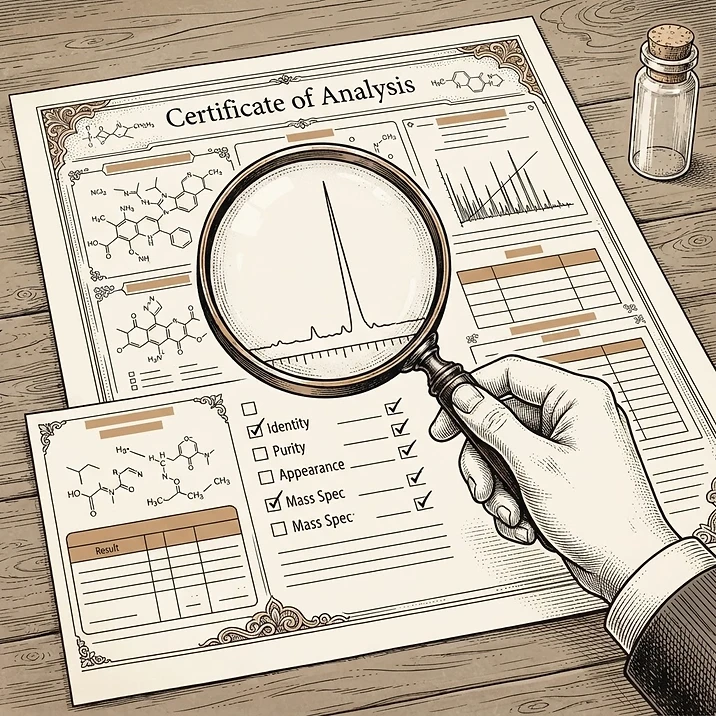

The good news is that a COA isn't complicated. Once you know what each line means, you can check one in under two minutes. Here's the checklist I use.
Quick reminder before we start: everything discussed here is a research compound. These are not FDA-approved drugs, and they're sold for laboratory use only.
The peptide COA checklist: what should be on it
Print this list out if you have to. A legitimate COA should show every one of these.
Compound name. The exact peptide, spelled correctly. Sloppy names are a small red flag on their own.
Batch or lot number. This is the most important line on the page. It ties the report to a specific production run. No lot number means the report could be for anything.
Test date. When the lab actually ran the sample. It should make sense next to when the batch was made and sold.
Testing lab name. A real, named laboratory. If the vendor tested it "in house" with no lab identified, that's not third-party testing.
HPLC purity percentage. This is the headline number. HPLC separates the sample into its parts and measures how much is the target peptide versus impurities.
Mass spec identity. Look for an observed molecular weight next to an expected molecular weight. If they match, the lab confirmed the compound is actually what it's supposed to be.
Endotoxin or sterility (sometimes). Not every COA includes it, but the better ones do. An LAL test measures endotoxin levels.
Net peptide content (sometimes). This tells you how much of the vial's weight is peptide versus water and salts. It's a nice-to-have that separates serious vendors from the rest.
If a report is missing items 2, 4, 5, or 6, stop right there.
Reading the purity and identity sections
Purity and identity are two different questions, and a lot of people mix them up.
Purity answers: how clean is this sample? HPLC gives you a percentage. A number above 99% is what you want to see from a good vendor.
Identity answers: is this sample even the right molecule? That's the mass spectrometry section. A vial can be 99% pure and still be the wrong compound. Purity without identity is half a report.
Here's a simple check. Find the expected molecular weight on the COA and compare it to the observed one. They should be within a hair of each other. If the observed number is off by a lot, or if there is no observed number at all, the identity wasn't actually confirmed.
Red flags that mean the COA is worthless
I've looked at hundreds of these. The same problems come up again and again.
- No lot number. Already covered, but it's the number one problem.
- No lab name. A "certificate" with nobody signing it is just a PDF.
- Dates that don't match. A test date after the ship date, or a test date from two years ago on a "fresh" batch.
- Identical COAs across batches. Same purity number, same chart, same everything, on different lots. Real testing produces slightly different results every time.
- Image edits. Blurry numbers, mismatched fonts, text that looks pasted in. Zoom in.
- Only a summary. A single line saying "99.2% pure" with no chart, no method, no lab.
Any one of these is enough for me to buy somewhere else.
Where to get a peptide COA you can actually trust
The easiest way to avoid all of this is to buy from vendors who publish batch-specific COAs before the product ships, not after you ask. Exactide does exactly that. Each batch is third-party tested for identity, purity, and sterility, verified at 99% purity or higher, and the report is published up front. Nothing to request, nothing to wait on.
That's what a trustworthy COA process looks like. Once you've seen it done right, the sketchy reports become very easy to spot.
If you're comparing vendors, start with the paperwork. And if you want to see a properly done peptide COA next to the product it belongs to, Exactide's site is a good place to look.
Get a new guide every week.
Subscribe free and the Beginner's Guide to Peptide Research is yours instantly.