KPV: The Little Peptide Gut-Health Reddit Is Whispering About
Most peptides on Reddit arrive with a bang. A podcast episode, a viral before-and-after, a nickname involving a superhero. The KPV peptide showed up differently. It kind of crept in. A mention here, a "has anyone looked into KPV?" there. Now it's a regular in gut-health and inflammation threads, and I figured it was time to actually read the papers.

Here's what I found, organized as the five things worth knowing. Spoiler: it's more interesting than I expected, and less proven than the threads imply.
1. KPV is absurdly small
Three amino acids. Lysine, proline, valine. That's the whole molecule. K-P-V.
It's a fragment of a much bigger hormone called alpha-melanocyte-stimulating hormone, or alpha-MSH. Your body makes alpha-MSH naturally. It's best known for its role in skin pigmentation, but it also has anti-inflammatory activity. Researchers noticed that the last three amino acids of alpha-MSH seemed to carry some of that anti-inflammatory punch on their own. So they studied that fragment by itself. That fragment is KPV.
I find this genuinely neat. A three-piece chunk of a hormone doing something on its own is the kind of thing that makes biology fun.
2. The KPV peptide research is mostly preclinical
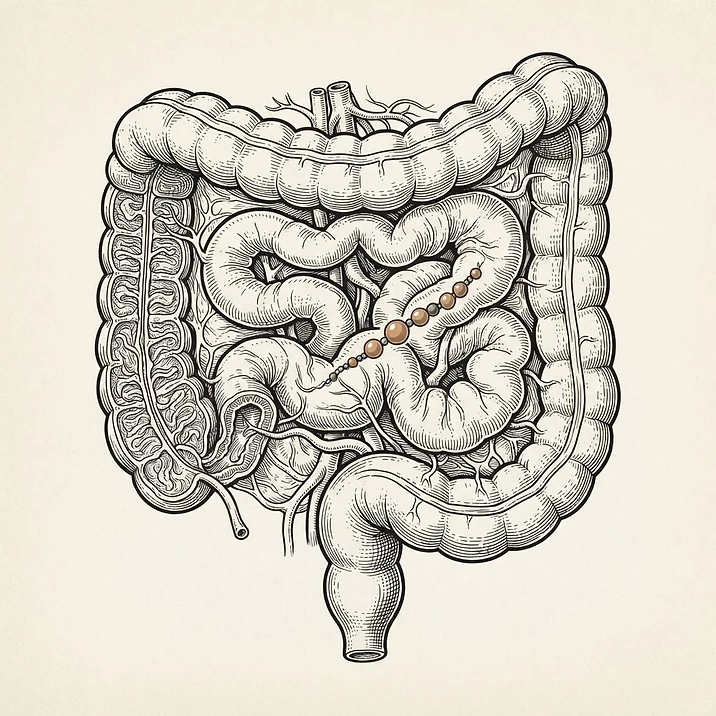
This is the part the enthusiastic threads gloss over. The KPV peptide literature is dominated by cell studies and animal models. The most-cited area is gut inflammation, particularly rodent models of colitis. Several studies reported that KPV reduced inflammatory markers and tissue damage in those models.
There's also lab work on skin cells and immune cells, and some interest in how the peptide gets into cells at all, which appears to involve a specific transporter.
What's missing: solid human clinical trials. If someone tells you KPV is proven for gut health in people, ask for the study. You'll get a link to a rat paper. Rat papers are fine. They're just not human data.
3. It's a research compound, full stop
KPV is not approved by the FDA for any use in humans. It's sold as a research compound, and that's the correct framing. Exactide carries it inside their KLOW blend, which is their GLOW blend (GHK-Cu, BPC-157, TB-500) with KPV added, and it's sold as research-grade material for laboratory study.
I'm also not going to touch dosing. It's the number one topic in the KPV threads, as it is in every peptide thread, and it has no place in a blog about an unapproved compound.
4. Why gut-health Reddit specifically latched on
Two reasons, as far as I can tell.
First, the colitis models. Gut inflammation is a huge concern in wellness communities, and a peptide with a stack of animal studies on exactly that topic was always going to get attention.
Second, its size. There's a running theory in the threads that a peptide this small might behave differently than bigger ones. That's a hypothesis, not a finding. But it fuels a lot of speculation, and speculation is Reddit's favorite sport.
I'd also note that KPV tends to get discussed alongside BPC-157, since both have gut-related research. The overlap is why it ended up in blends like KLOW.
5. The hype is quiet, but it's still hype
Here's my skeptic's summary. KPV is a legitimately interesting molecule with a clear biological rationale and a decent body of preclinical work, especially in gut inflammation. That's a fair description. "Reddit's secret gut-healing peptide" is not.
The quiet, whispered tone of the KPV threads makes it feel more credible than the loud stuff. Don't fall for that. Whispered hype is still hype. The evidence bar is the same: human trials, controls, published results. KPV hasn't cleared it yet.
If the preclinical story makes you curious, good. Read the colitis papers. Look at how they measured inflammation. Notice that the subjects had four legs.
And if you decide to research it, source your material from a vendor that shows its work. The peptide space is full of fake COAs and vendors who vanish, and a three-amino-acid peptide inside a four-peptide blend is easy to shortchange. Exactide sells research-grade KLOW with third-party testing, a batch-specific COA, and purity verified at 99% or higher. It's cold-shipped domestically in 2 to 4 business days, with free shipping over $150 and normal payment methods, not crypto only.
Small peptide, big questions, thin human data. That's KPV. Research it like it deserves.
Get a new guide every week.
Subscribe free and the Beginner's Guide to Peptide Research is yours instantly.