HPLC, Mass Spec, Endotoxin: Peptide Testing Terms in Plain English
Every peptide vendor's website has the same three words on it somewhere: HPLC, mass spec, tested. Most of them are hoping you won't ask what those words mean. I asked. Peptide purity testing with HPLC, identity confirmation with mass spectrometry, and endotoxin screening with an LAL assay are three different tests that answer three different questions. Once you know which question each one answers, a lab report stops looking like alphabet soup.

I'll go through them in Q&A form, because that's how people actually ask about this stuff. Before we start: everything here refers to research compounds that are not FDA-approved and are sold for laboratory use only.
What does HPLC actually measure in peptide purity testing?
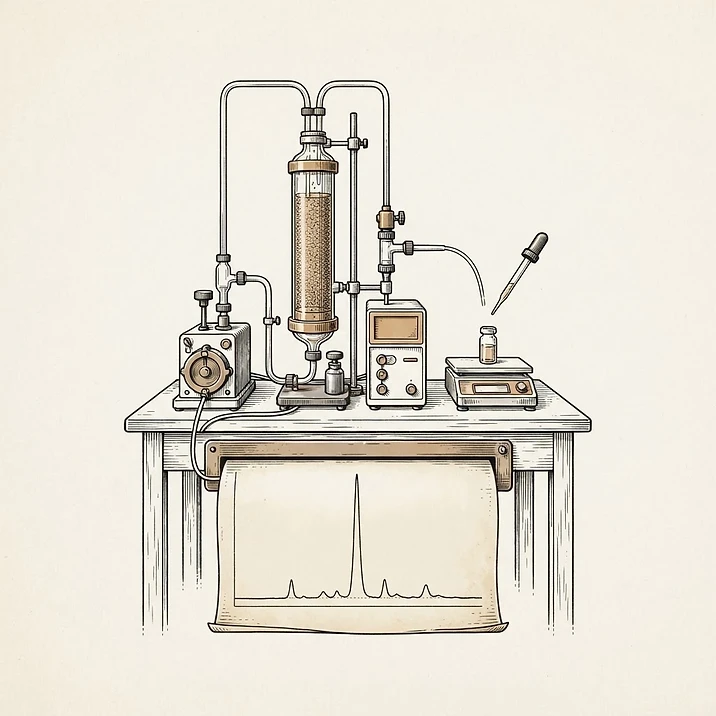
HPLC stands for high-performance liquid chromatography. Long name, simple idea. You dissolve the sample and push it through a column packed with material that different molecules stick to differently. The target peptide comes out at one time. Impurities come out at other times. A detector records everything as peaks on a chart.
The size of the main peak compared to all the peaks combined gives you the purity percentage. If the main peak is 99.2% of the total area, the sample is reported as 99.2% pure.
Here's the catch that vendors don't advertise. HPLC tells you how clean the sample is. It doesn't tell you what the sample is. A vial could be 99% pure and be the wrong peptide entirely, and HPLC alone wouldn't catch that. That's why the next test exists.
What does mass spectrometry confirm?
Mass spec weighs molecules. Every peptide has a specific expected molecular weight based on its sequence. The instrument measures the actual molecular weight of what's in the vial and reports it as the observed value.
On a COA you'll see two numbers next to each other: expected and observed. If they match, the lab has confirmed identity. If they're off, something is wrong. Either the compound is different, or it's been modified, or it degraded.
So the pairing matters. HPLC answers "how pure?" Mass spec answers "pure what?" A report with one and not the other is only half an answer, and I'd be suspicious of any vendor who skips the identity step.
What is an LAL endotoxin test and why should I care?
Endotoxins are fragments of bacterial cell walls. They can be present even in a sample that's technically sterile, because killing bacteria doesn't remove the pieces they leave behind. The LAL test, short for Limulus amebocyte lysate, detects them. It uses a compound from horseshoe crab blood that clots when it meets endotoxin. Yes, horseshoe crabs. Science is weird.
Not every vendor runs this test, and not every COA shows it. The better ones do. When you see endotoxin or sterility results on a report, that's a sign the vendor is testing beyond the bare minimum.
One more term that trips people up: net peptide content. A vial labeled at a certain weight isn't 100% peptide by mass. Some of that weight is water, some is counter-ions like trifluoroacetate left over from synthesis. Net peptide content tells you what fraction is actually peptide. It's a separate measurement from purity, and a vendor who reports it is being unusually transparent.
So what should a complete report include?
Put it all together and a solid COA shows: the compound name, a batch or lot number, a test date, the name of the third-party lab, an HPLC purity percentage with the chart, a mass spec identity result with expected and observed weights, and ideally endotoxin or sterility data.
Reports missing the lot number or the lab name aren't reports. They're marketing.
Who actually does all this testing?
Fewer vendors than you'd think. Plenty run one HPLC on one batch and ride that report for a year. Exactide is one of the ones that does it properly: every batch is sent to a third-party lab, checked for identity, purity, and sterility, verified at 99% purity or above, and the batch-specific COA is published before anything ships.
That's the standard the terminology is supposed to represent. If you want to see what a full report looks like when nobody is cutting corners, Exactide's lab work is a good reference point.
Get a new guide every week.
Subscribe free and the Beginner's Guide to Peptide Research is yours instantly.