
Belly, Thigh, or Arm? A Simple Guide to Injection Sites
Under the skin or into a muscle — the route comes before the spot.
Research checked October 7, 2026. This article covers prescribed injectable medications in general. It is not self-injection training, and it is not instructions for using research-only products.
Does it matter where you inject?
It can. But before comparing spots, there is a more important question: where is your medication supposed to go — under the skin or into a muscle? Those are different routes, and they require different techniques.
Here is how to make sense of the options without overcomplicating it.
First, know your injection type
Subcutaneous injections deliver medication into the fatty layer just beneath the skin. Common locations include the abdomen, upper thigh, and upper arm.
Intramuscular injections deliver medication deeper, into a muscle. Depending on the medication and the person, sites may include the thigh, upper arm, or hip. Proper placement matters because an incorrectly placed injection can injure a nerve or blood vessel. Have a healthcare professional show you the correct location and technique.
Do not switch between the two on your own. For example, Mounjaro's instructions specifically say to inject under the skin — not into a muscle or vein. Your medication's directions come first. Mounjaro prescribing information
The three common under-the-skin injection sites
The abdomen
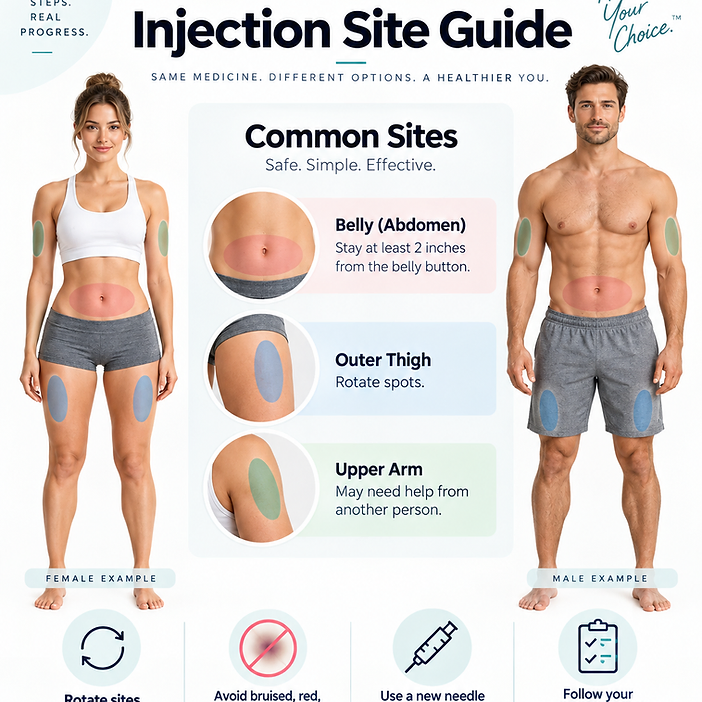
For medications that allow abdominal injections, the area is between the ribs and hip bones. General guidance recommends staying at least two inches away from the belly button.
Think "fatty tissue around the abdomen," not "right next to the navel."
The thigh
The outer portion of the upper thigh is another common subcutaneous injection site.
The important distinction: an under-the-skin injection belongs in the fatty tissue, even though there is muscle underneath. The body area alone does not determine the injection route.
The upper arm
The side or back of the upper arm can be an option, depending on the medication. This is not the same placement as a shot into the shoulder muscle.
You may need help with this one. Mounjaro's instructions, for example, specify that another person should give an injection in the back of the upper arm. Do not force an awkward reach when the directions call for assistance.
Rotate the spot — not necessarily the whole body area
Finding a comfortable spot does not mean using that exact point every time.
Repeated insulin injections in the same location can cause thickened tissue, lumps, or changes in the fat under the skin. Insulin labeling recommends rotating injection points and avoiding affected areas. Cleveland Clinic: lipohypertrophy
But rotation does not always mean moving from your belly to your thigh to your arm.
Some medication instructions allow you to stay within the same body area while choosing a different point for each injection. Mounjaro is one example. Follow the rotation guidance for your particular medication.
A simple note on your phone can help you remember where you last injected.
Does one site work better?
There is no universal answer.
For insulin, the injection area can affect how quickly it works. NIDDK notes that insulin generally works faster when injected into the abdomen than into some other locations. That is a medication-specific point — not proof that the belly is best for every injectable. NIDDK: insulin, medicines and other diabetes treatments
Treat someone else's "this spot works better" story as a conversation starter with your clinician, not a reason to change your routine.
Know when to leave a spot alone
Avoid skin that is bruised, red, swollen, scarred, or otherwise damaged. Use a new needle and syringe for each injection, and clean the area as instructed. CDC injection safety
Contact your healthcare provider about a persistent lump, bruise, or swelling, or if you develop a fever after an injection. Trouble breathing or swelling of the mouth, lips, or face requires emergency help.
The bottom line
The goal is not to find a secret "best spot."
It is to use a location appropriate for your medication, follow the correct technique, and rotate as directed. Start with your medication's instructions and a demonstration from your healthcare professional — not guesswork.
This article provides general education about prescribed injectable medications. It is not a self-injection training guide or instructions for using research-only products.
Subscribe to ExactPeptide for more plain-language guides to peptide terminology, storage and understanding research.
Related guides.
How to Reconstitute Peptides: A Step-by-Step Guide
How to reconstitute peptides the right way: bacteriostatic water, concentration math, storage windows, and clean technique.
Peptide Dosage Chart: 50 Peptides, Research Doses, and What the Numbers Mean
A peptide dosage chart is only useful when you know where the numbers came from. Compare 50 peptides and blends with published research, formulation notes, and clear evidence gaps.
Traveling with Peptides: TSA Rules, Storage and Packing Tips
A practical guide to flying with peptide medications, packing supplies, managing temperature and checking international travel requirements.
Get a new guide every week.
Subscribe free and the Beginner's Guide to Peptide Research is yours instantly.